
Type OPENAI into a stock app and you get nothing; the company has no ticker. In Tickers for the Tickerless it has the fullest chart on the board: six reported rounds since January 2023, each with a named source, ending at a reported $840B in February 2026. Here is how to read it, using only what the tool shows.
1. Read the rounds, not the line
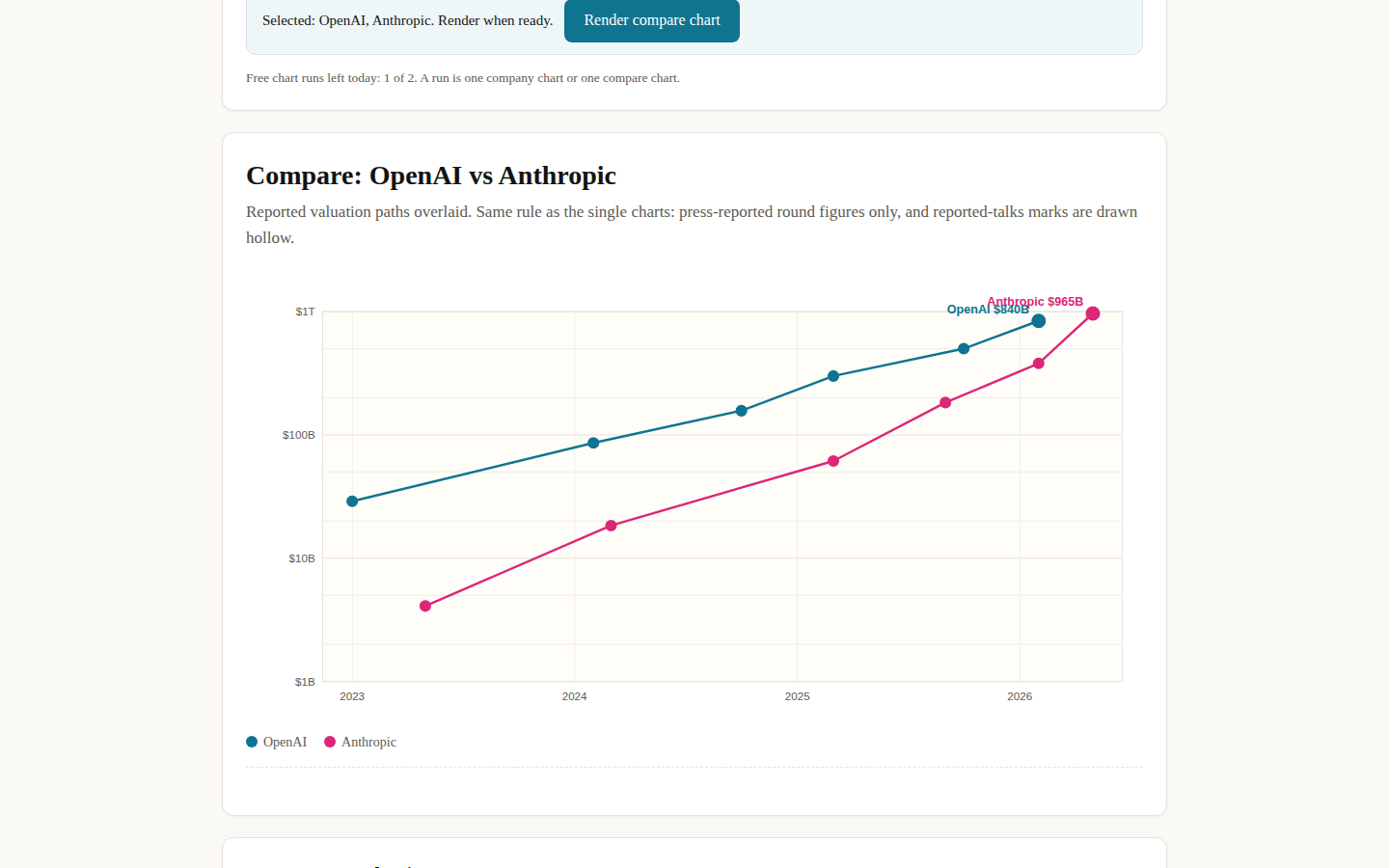
January 2023, Microsoft strategic investment, $29B, as reported by Reuters. February 2024, a tender offer, $86B, as reported by The New York Times. October 2024, a funding round, $157B, as reported by OpenAI itself. March 2025, a SoftBank-led round, $300B. October 2025, a secondary share sale, $500B, as reported by Reuters. February 2026, a funding round announced as $110B raised at a $730B pre-money valuation, $840B post-money. The connecting line is a drawing aid; the rounds are the data. The company's own announcements sit on its news page if you want the primary source.
2. Know which kind of round you are looking at
The tool separates primary rounds (new money in at a priced round), tender offers (employees sell at a set price, no new money), secondary sales (existing holders sell, reported after the fact) and reported talks (drawn hollow and labelled, never counted as closed). OpenAI's path mixes all of them, which is normal for a company this size and exactly why the labels matter.
3. Do the two divisions the tool does for you
Latest against previous: 1.68x, a 68 percent step from the October 2025 secondary to February 2026. Biggest single jump: 2.97x, from the Microsoft investment to the tender offer. And one quiet line under the chart: reported revenue of $20B, annualized, shown as a diamond series of its own. Our AI stocks ranked by real spending applies the same revenue discipline to public names.
4. Put the rival next to it
The compare view overlays Anthropic: its latest reported point is $965B, a Series H, as reported by Bloomberg in May 2026, ahead of OpenAI on the latest marks while trailing it for most of the path. That is the honest way to say "who is winning": two dated, sourced points, not a vibe. The Global Portfolio Builder on our sister site covers the public-market side of the same question.
5. Remember what the chart cannot say
Between rounds, OpenAI's value was unknown, and the chart leaves those stretches as a straight line between two reports, nothing more. There is no ticker because there is no market; nothing here is investment advice, and the tool says so on its own page. When a company on the board does go public, it leaves the board: it has a ticker now, and a different chart. New to the tool? The short explainer covers the four round types first, then open the Tickers for the Tickerless and check the company you keep hearing about.